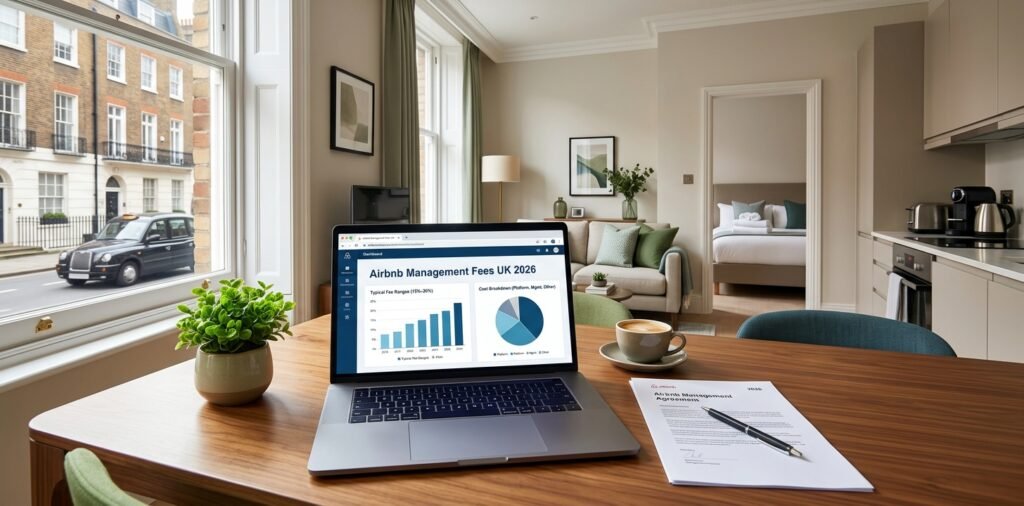
Most UK landlords should expect to pay approximately 15% to 20% of booking revenue for full Airbnb management in 2026, although advertised rates can range from around 12% to 25%. VAT, onboarding, cleaning, linen, maintenance and monthly software charges may be added separately.
A lower percentage does not always mean a cheaper service. To understand the real cost of Airbnb management UK landlords must compare:
- Whether the commission is calculated on gross or net revenue
- Whether VAT is included
- Which management services are covered
- Whether cleaning and linen are charged separately
- Onboarding and photography costs
- Maintenance mark-ups
- Monthly account or software fees
- Contract length and cancellation terms
The right price is therefore not necessarily the lowest percentage. It is the fee that produces the strongest net return while providing the level of operational support the property requires.
How Much Are Airbnb Management Fees in the UK in 2026?
Professional rental property management can reduce a landlord’s daily workload by coordinating bookings, guests, cleaning and ongoing property requirements.
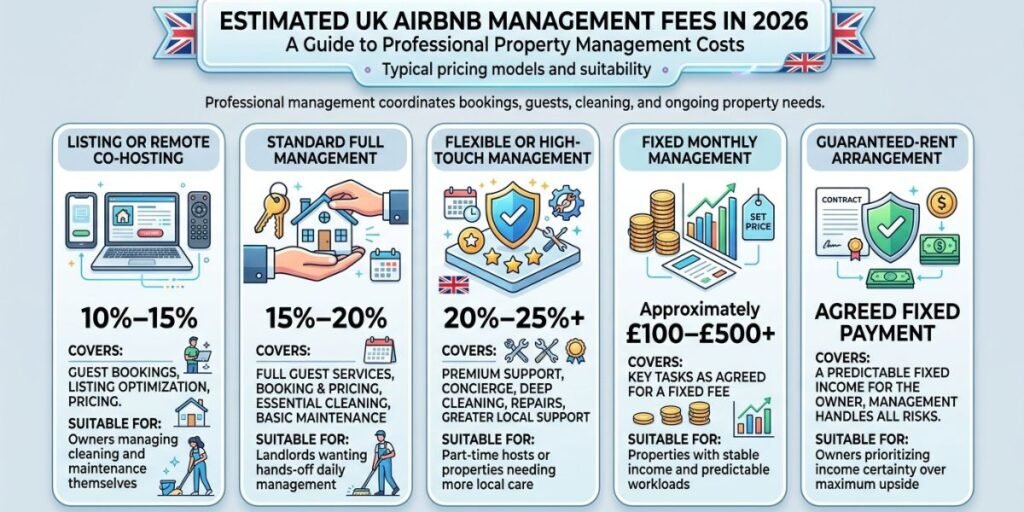
Published UK pricing indicates that most Airbnb property management fees fall into the following ranges:
| Management level | Typical fee | Usually suitable for |
|---|---|---|
| Listing or remote co-hosting | 10%–15% | Owners managing cleaning and maintenance themselves |
| Standard full management | 15%–20% | Landlords wanting hands-off daily management |
| Flexible or high-touch management | 20%–25%+ | Part-time hosts or properties needing greater local support |
| Fixed monthly management | Approximately £100–£500+ | Properties with stable income and predictable workloads |
| Guaranteed-rent arrangement | Agreed fixed payment | Owners prioritising income certainty over maximum upside |
These figures are not a regulated national tariff. Charges vary by location, property type, annual availability, anticipated revenue and the work included.
For comparison, current providers advertise fees starting around 12%, while some flexible management packages reach 20%. Certain companies also add VAT, onboarding fees or monthly account charges. HelloGuest advertises management from 12% excluding VAT, while Houst publishes plans ranging from 14% to 20% in several UK cities.
A quote of 20% that covers everything may be better value than a 12% quote followed by charges for photography, linen, inspections, maintenance coordination and account management.
What Are Airbnb Property Management Fees?
Our complete Airbnb property management service supports landlords with listing optimisation, pricing, guest communication, cleaning coordination and daily operations.
Airbnb property management fees are payments made to a professional manager or co-host for operating a short-term rental on the property owner’s behalf.
Unlike a traditional letting agent, an Airbnb manager may need to manage activity every day. Bookings can start and finish several times each month, and every reservation creates new operational work.
A full management service will normally include some combination of:
- Airbnb listing creation and optimisation
- Professional photography coordination
- Dynamic nightly pricing
- Calendar and availability management
- Guest enquiries
- Reservation management
- Guest screening
- Check-in instructions
- Check-out communication
- Review management
- Cleaning coordination
- Linen and laundry coordination
- Maintenance reporting
- Emergency guest support
- Owner statements
- Performance reporting
- Distribution across additional booking platforms
The exact scope differs between companies. Landlords should never assume that the phrase “full management” has the same meaning in every proposal.
What Should a Full Management Fee Include?
A competitive full-service fee of around 15% to 20% should normally cover the majority of recurring management work.
Listing creation and optimisation
The manager should create or improve the listing title, description, amenities, house rules, image order and guest information.
The service should also explain whether the owner retains control of the listing and what happens to reviews if the management agreement ends.
Dynamic pricing
Rates should respond to:
- Seasonal demand
- Weekends
- School holidays
- Local events
- Booking lead time
- Remaining availability
- Minimum-stay requirements
- Competitor pricing
- Current occupancy
Dynamic pricing should involve more than switching on automated software. A manager should review whether the pricing strategy is attracting the right bookings and generating an acceptable net return.
Guest and reservation management
Full management should normally include pre-booking questions, booking confirmation, arrival information, access instructions, in-stay support and check-out communication.
Ask whether support is genuinely available 24 hours a day or whether emergency enquiries are handled through an automated system outside normal office hours.
Cleaning and changeover coordination
The management fee will often cover arranging cleaners, but it may not include the actual cleaning cost.
Confirm who pays the cleaner, whether the guest cleaning fee covers the full cost and whether the management company adds a mark-up.
Maintenance coordination
Managers will usually report maintenance issues and arrange approved contractors. However, the contractor’s invoice and replacement materials are normally paid separately by the owner.
The agreement should state the amount the manager can approve without contacting the landlord.
Owner reporting
A landlord should be able to see:
- Confirmed bookings
- Gross booking revenue
- Platform deductions
- Management fees
- Cleaning charges
- Maintenance costs
- Refunds and cancellations
- Final owner payout
Transparent reporting is particularly important when a property appears on Airbnb, Booking.com and direct-booking channels with different commission structures.
Landlords advertising across multiple booking channels may benefit from professional short term rental management that connects pricing, availability, guest support and property changeovers.
The Four Main Airbnb Management Fee Models
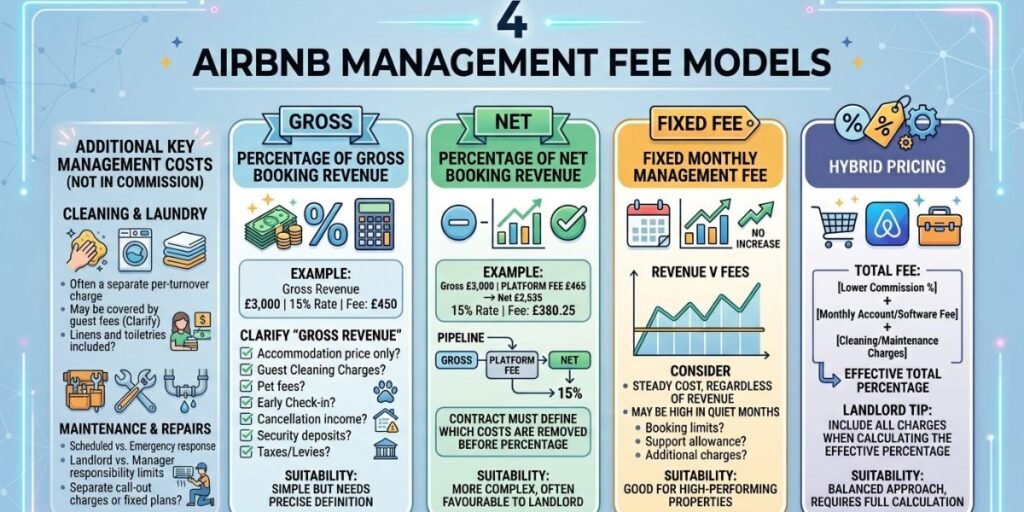
1. Percentage of gross booking revenue
This is one of the most common arrangements. The management company charges a percentage of the total booking revenue before platform charges and operating expenses are deducted.
For example:
- Gross monthly booking revenue: £3,000
- Management rate: 15%
- Management fee: £450
This structure is simple, but landlords must establish what the company includes within “gross revenue.”
Does it include:
- The accommodation price only?
- Cleaning charges paid by the guest?
- Pet fees?
- Early check-in charges?
- Cancellation income?
- Security deposits?
- Taxes or visitor levies?
These details can materially change the final management cost.
2. Percentage of net booking revenue
Some managers calculate commission after the booking platform has deducted its fee.
Suppose a property generates £3,000, and £465 is deducted as the platform fee:
- Revenue after platform fee: £2,535
- Management fee at 15%: £380.25
The difference between charging 15% on gross revenue and 15% after the platform fee is £69.75 in this example.
A net-revenue commission may look more favourable, but the contract must clearly define which costs are removed before the percentage is calculated.
3. Fixed monthly management fee
A fixed-fee manager charges the same amount each month regardless of bookings.
This arrangement can work well for a high-performing property because the management cost does not increase with revenue. However, a fixed fee may be expensive during quiet months or extended periods when the property is unavailable.
Landlords should also ask whether the fixed price includes a booking limit, support allowance or additional charges for each changeover.
4. Hybrid pricing
A hybrid agreement combines a lower commission with a monthly account, software or support fee.
For example:
- 12% booking commission
- £40 monthly account fee
- Separate cleaning and maintenance charges
Hybrid pricing is not necessarily unfair, but all charges should be included when calculating the effective percentage.
Gross Versus Net Revenue: Why the Difference Matters
Two companies can both advertise a 15% fee while charging different amounts.
Consider a property generating £36,000 in annual booking revenue.
Manager A: 15% of gross revenue
- Annual booking revenue: £36,000
- Management charge: £5,400
Manager B: 15% after a 15.5% platform fee
- Platform fee: £5,580
- Remaining revenue: £30,420
- Management charge: £4,563
The difference is £837 a year before VAT and other expenses.
Neither method is automatically wrong. What matters is that the calculation is defined in writing before the management contract begins.
Does VAT Apply to Airbnb Management Fees?
VAT is one of the most frequently overlooked parts of short-term rental management fees.
The standard UK VAT rate is currently 20% for most goods and services. If a VAT-registered management company quotes a fee excluding VAT, VAT will normally be added to its invoice. See the current UK VAT rates.
VAT is charged on the management fee—not by adding 20 percentage points to the commission rate.
| Advertised management fee | VAT added to fee | Effective cost against revenue |
|---|---|---|
| 12% | 2.4% | 14.4% |
| 15% | 3% | 18% |
| 18% | 3.6% | 21.6% |
| 20% | 4% | 24% |
Therefore, a quotation of 15% plus VAT has an effective management cost of 18% of the relevant booking revenue.
Before accepting a proposal, ask:
Is the advertised percentage inclusive or exclusive of VAT?
The answer should appear clearly in the written fee schedule.
Is the Airbnb Platform Fee Included?
No. Airbnb’s own service fee and the property manager’s fee are normally separate charges.
Airbnb currently operates two primary fee structures for home bookings:
- Under the split-fee structure, most hosts pay approximately 3%, while guests pay a separate service fee.
- Under the single-fee structure, most hosts pay 15.5%, with typical charges ranging from 14% to 16%.
Airbnb states that the single-fee structure is mandatory for certain hosts, including listings using property-management software and traditional hospitality listings. Airbnb also states that its displayed service fees are VAT-inclusive where applicable. See Airbnb’s current service-fee guidance.
This distinction is important because a landlord could pay:
- Airbnb’s platform fee
- A management commission
- VAT on the management service
- Cleaning and linen expenses
- Other property operating costs
A 15% management fee does not mean total deductions will be limited to 15%.
A Realistic Airbnb Management Cost Example
Consider a property generating £3,000 in monthly booking revenue.
For illustration, assume:
- Airbnb single host fee: 15.5%
- Property management fee: 15% of gross revenue
- Management fee quoted excluding VAT
- Cleaning and maintenance excluded from this calculation
| Item | Calculation | Amount |
|---|---|---|
| Gross booking revenue | — | £3,000 |
| Airbnb platform fee | 15.5% | £465 |
| Management fee | 15% | £450 |
| VAT on management fee | 20% of £450 | £90 |
| Remaining before other property costs | — | £1,995 |
The headline management rate was 15%, but the combined platform and management deductions totalled £1,005.
Cleaning, linen, utilities, insurance, maintenance, council charges, supplies, mortgage costs and tax have not yet been deducted.
This example does not mean every property will follow the same fee structure. It demonstrates why landlords must calculate net income rather than choosing a manager based solely on the headline commission.
How an Onboarding Fee Changes the First-Year Cost
An onboarding fee may cover:
- Initial property inspection
- Photography
- Listing creation
- Account setup
- Pricing configuration
- Guest guide creation
- Compliance checks
- Smart-lock or key-safe setup
- Inventory preparation
Suppose a manager charges 15% of gross revenue plus a £500 onboarding fee.
For a property generating £30,000 in its first year:
- Annual management commission: £4,500
- Onboarding fee: £500
- First-year management cost: £5,000
- Effective first-year rate before VAT: approximately 16.7%
For a property generating £60,000:
- Annual management commission: £9,000
- Onboarding fee: £500
- First-year management cost: £9,500
- Effective first-year rate before VAT: approximately 15.8%
An onboarding fee has a greater effect on lower-revenue properties. Landlords should include it when comparing first-year projections.
Additional and Hidden Costs to Check
Cleaning and linen
Cleaning coordination may be included while the actual cleaner, laundry and linen costs remain separate.
Airbnb describes the cleaning fee as a one-off host-set charge forming part of the guest’s total price. Airbnb cleaning-fee guidance.
Ask whether:
- The guest pays the full cleaning cost
- The company keeps any difference
- VAT is added
- Linen is included
- Deep cleans cost extra
- The manager charges commission on the guest’s cleaning fee
Photography
Some managers include initial photography, while others charge separately. Ask who owns the photographs if the agreement ends.
Monthly account or software fees
Some providers add a monthly charge for the owner dashboard, pricing software or account administration. These charges matter most for properties with lower booking revenue.
Maintenance mark-ups
A manager may charge:
- A percentage of the contractor invoice
- A call-out fee
- An administration fee
- A monthly maintenance plan
Request written approval limits and invoices for completed work.
Guest consumables
Toiletries, tea, coffee, cleaning products, bin bags and welcome items may be billed to the owner. Find out whether the manager charges the retail cost or adds a restocking margin.
Emergency support
Out-of-hours visits, lost-key support and emergency call-outs may not be part of the standard fee.
Contract and exit charges
Check for:
- Minimum contract periods
- Notice requirements
- Early termination fees
- Listing-transfer charges
- Photography ownership
- Treatment of future reservations
- Responsibility for refunds after termination
What Determines the Cost of Airbnb Management UK Landlords Pay?
Property location
A city-centre flat with nearby cleaners and contractors may be easier to manage than a remote holiday home. Local wages, travel time and operational availability can influence the fee.
Property size and complexity
A large house accommodating several guests normally requires more communication, cleaning and maintenance than a studio apartment.
Hot tubs, gardens, parking arrangements and complex access systems can create additional management work.
Booking frequency
A property receiving ten short reservations can require considerably more work than one receiving a single month-long contractor booking, even if both generate similar revenue.
Owner availability
Full-time properties may qualify for lower percentage rates because they provide consistent booking opportunities. Part-time homes can attract higher fees because revenue is limited while setup and account-management work remain necessary.
Level of service
Remote co-hosting is cheaper because the owner retains responsibility for physical operations. Full management costs more because the manager coordinates both guest communication and local property requirements.
Contract length
Some companies reduce their commission when an owner accepts a longer commitment. A lower rate should be weighed against reduced flexibility if service standards decline.
Are Cheaper Airbnb Management Fees Better?
Not necessarily.
A cheap manager may produce a weaker net result if they:
- Respond slowly to guests
- Use static pricing
- Fail to optimise the listing
- Depend on one booking platform
- Provide inconsistent cleaning
- Do not manage reviews
- Add undisclosed charges
- Lack local operational support
For example, compare these two hypothetical services:
| Manager | Gross bookings | Total management cost | Owner position before other costs |
|---|---|---|---|
| Manager A: 12% effective cost | £2,500 | £300 | £2,200 |
| Manager B: 18% effective cost | £3,000 | £540 | £2,460 |
Manager B costs more but leaves the owner with £260 more before platform and property expenses.
However, revenue-improvement claims should never be accepted without evidence. Ask for comparable property case studies rather than guaranteed percentages.
How Much More Must a Manager Earn to Cover Their Fee?
This is an important calculation that many fee guides overlook.
Suppose:
- Your current gross bookings are £3,000 per month
- Airbnb’s host fee remains 15.5%
- The manager charges 15% plus VAT, producing an effective 18% management cost
- Cleaning and other operating expenses remain unchanged
Without management:
- £3,000 minus 15.5% platform fee
- Remaining amount: £2,535
With management, approximately 66.5% of gross revenue remains after the assumed platform and management percentages.
The manager would need to increase gross monthly bookings to approximately £3,812 to leave the same £2,535 before other expenses.
That represents an increase of roughly 27%.
This does not mean management is only worthwhile if income increases by 27%. Landlords may also be paying for:
- Time saved
- Reduced guest-management workload
- Local availability
- Improved consistency
- Fewer operational mistakes
- Multi-platform management
- Professional property oversight
Nevertheless, the calculation helps separate convenience from financial performance.
Are Airbnb Management Fees Tax-Deductible?
Management and letting-agent fees may generally be allowable expenses when calculating rental profit, provided they meet the relevant conditions.
HMRC includes letting-agent and management fees among common allowable property expenses. The expense normally needs to be incurred wholly and exclusively for the rental business and must not be capital expenditure. Review HMRC’s rental-income guidance.
Tax treatment depends on property ownership, accounting method, allowances and the individual landlord’s circumstances. Obtain advice from a qualified accountant rather than treating general guidance as personal tax advice.
How to Compare Short-Term Rental Management Fees
Ask every potential manager the same questions and request written answers.
Fee calculation
- What is the management percentage?
- Is VAT included?
- Is commission based on gross or net revenue?
- Does the calculation include cleaning fees and other guest charges?
- Is commission charged on cancelled or refunded reservations?
Services
- Is listing creation included?
- Is professional photography included?
- Which booking platforms are supported?
- Is dynamic pricing included?
- Is guest support available outside office hours?
- Who coordinates cleaning and linen?
- Are property inspections included?
- How are maintenance issues handled?
Additional charges
- Is there an onboarding fee?
- Is there a monthly account or software fee?
- Is cleaning marked up?
- Are contractor invoices marked up?
- Are emergency call-outs charged separately?
- Who pays for guest consumables?
Control and reporting
- Who owns the Airbnb listing?
- Where are guest payments received?
- Can the owner block dates?
- How frequently are statements issued?
- Can the owner view bookings and revenue?
- What happens to future bookings if the contract ends?
Contract terms
- What is the minimum contract period?
- How much notice is required?
- Is there an exit fee?
- Can the manager change the fee during the agreement?
- What happens if agreed service standards are not met?
Warning Signs When Comparing Management Companies
Be cautious if a company:
- Will not provide a complete written fee schedule
- Avoids explaining whether VAT is included
- Cannot define gross or net booking revenue
- Guarantees income without assessing the property
- Charges commission on taxes or refundable deposits
- Adds unexplained maintenance mark-ups
- Does not provide access to booking information
- Cannot show relevant local experience
- Uses a long contract without a reasonable termination process
- Does not explain who owns the listing and reviews
- Provides no clear process for complaints or emergencies
Professional management should reduce uncertainty, not create it.
How Short Stay Solutions Structures Its Management Fee
Short Stay Solutions provides full Airbnb and short-let management for landlords in selected locations across England and Scotland.
The currently advertised full-management structure is:
- 15% of gross revenue
- £500 onboarding fee
The service covers areas such as guest communication, cleaning coordination, maintenance coordination and revenue optimisation. Property-specific costs and requirements may vary, so landlords should request a written assessment before proceeding. View the management pricing.
A free property assessment can help establish:
- Whether the property is suitable for short-term letting
- Which booking channels may be appropriate
- The level of management required
- Likely onboarding requirements
- Property-specific operating costs
- The intended guest market
- Local operational and compliance considerations
Frequently Asked Questions
What is the average Airbnb management fee in the UK?
Most UK full-management services charge approximately 15% to 20% of booking revenue. The broader market can range from around 12% to 25%, depending on the location, contract, availability and services included.
Is 15% a reasonable Airbnb management fee?
Yes. A 15% fee can be competitive for full management if it includes listing optimisation, pricing, guest communication, booking support, cleaning coordination and owner reporting.
Confirm whether the 15% is charged on gross or net revenue and whether VAT is included.
Do landlords pay Airbnb fees and management fees?
Usually, yes. Airbnb’s platform service fee and the management company’s commission are separate deductions.
Are cleaning costs included in Airbnb management fees?
Cleaning coordination may be included, but the actual cleaning and linen costs are frequently charged separately or covered through a guest cleaning fee.
Can a manager charge commission on the cleaning fee?
A manager can calculate its commission according to the basis established in the contract. Landlords should ask whether “gross revenue” includes cleaning and other guest-paid charges.
Why do part-time hosts sometimes pay higher fees?
The manager still needs to create listings, maintain accounts, communicate with guests and operate the property, but there are fewer available nights from which to generate commission.
Are fixed fees better than percentage fees?
Fixed fees can benefit high-revenue properties, while percentage fees reduce the owner’s cost during quieter periods. The better model depends on booking performance and the services included.
What is a fair onboarding fee?
There is no standard onboarding price. Its fairness depends on whether it includes photography, listing creation, compliance checks, account setup, guest guides and property preparation.
Should I choose the cheapest Airbnb manager?
Choose the manager expected to deliver the best net result, operational reliability and owner visibility. The lowest headline percentage is not always the lowest total cost.
Final Answer: What Should UK Landlords Really Pay?
For full Airbnb management in 2026, 15% to 20% of booking revenue is a reasonable UK benchmark. Fees below this range may offer good value, but landlords should confirm which services are excluded. Charges above 20% may still be justified for flexible availability, complex properties or extensive local support.
Before signing, calculate the complete cost:
Platform fee + management commission + VAT + onboarding + cleaning + linen + maintenance + monthly charges.
The most important figure is not the advertised management percentage. It is the amount you keep after every fee—and whether the management service saves time, protects the property and supports sustainable booking performance.
Landlords considering professional support can request a free property assessment to discuss their property, location and management requirements.